

What a Self-Skippered Catamaran Charter Really Costs: A Line-by-Line Breakdown
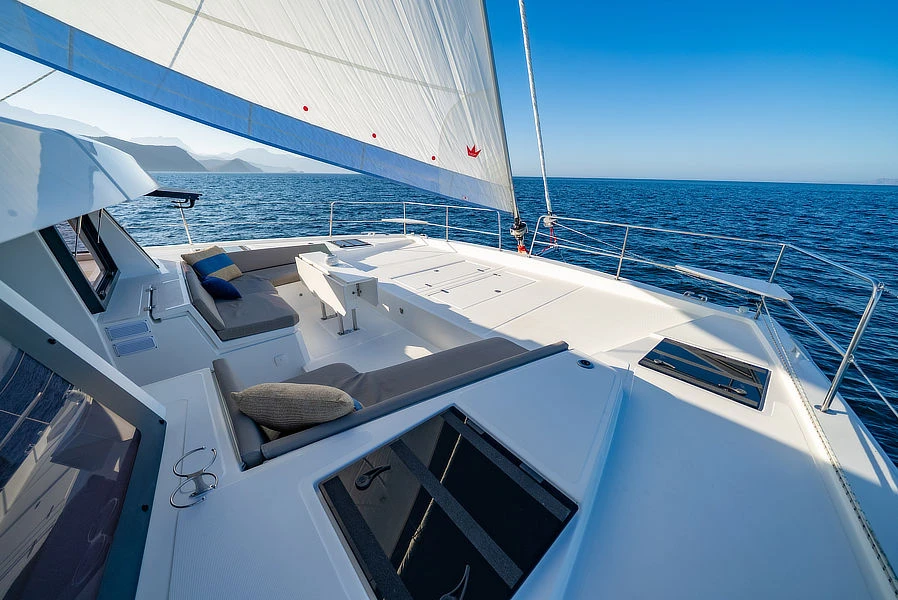
What a self-skippered catamaran charter really costs comes down to five line items: the base charter fee, mandatory extras, fuel, provisioning, and a refundable security deposit. Once you can see how each one moves, comparing quotes for a Bareboat Charters trip takes minutes instead of guesswork.
By Blue Pacific Yachting Team, USCG-Licensed Captains & ASA-Certified Sailing Instructors
The starting point for any bareboat quote is the base charter fee, the flat weekly rate charged for the boat itself. That number moves with three things: the catamaran's size and cabin count, the season, and the base you're chartering from. A newer four or five cabin catamaran commands a higher base fee than an older or smaller boat, and high season, whenever demand peaks in that particular cruising ground, always prices above shoulder or low season. Charter prices on a per person per day basis drop quickly as your group grows toward the boat's berth count, since the same weekly rate is simply split more ways.
What's Included in the Base Price
The base fee generally covers the boat itself, standard safety and navigation gear, the dinghy and its outboard motor, bedding for the stated number of cabins, and a chart briefing before you leave the dock. It does not usually include fuel, final cleaning, or consumables. Luxury amenities like a watermaker, generator, air conditioning, or ice maker, when a boat has them, push the base rate higher, since operators treat those as premium features rather than standard equipment. Cabin counts vary by hull, and comparing layouts across Our Fleet before requesting a quote helps match berths to your group instead of guessing from a spec sheet.
The same catamaran can carry a meaningfully different weekly rate depending on which coast it sails from, and Marina del Rey charter rates reflect that market's own supply and demand rather than a single national average.
What Extra Fees Come With a Bareboat Catamaran Charter
Beyond the base fee, expect a short, fairly predictable list of add-ons. A final cleaning fee is nearly universal and covers turning the boat around for the next charter. An outboard motor fee for the dinghy is sometimes bundled into the base price and sometimes billed separately, so ask which applies before you book. Linen and towel packages are often optional; skipping them saves a modest amount if you bring your own. Some operators also charge a one-time provisioning delivery or galley-kit fee that is separate from the food itself. None of these fees individually rival the base charter fee, but stacked together they can add a noticeable percentage to the bottom line, which is exactly why asking for an itemized quote up front matters more than comparing headline day rates.
Budgeting for Fuel and Provisioning on a Self-Skippered Charter
Fuel
Fuel is billed as a variable cost, either as a flat estimated amount collected up front and reconciled against the fuel dock receipt at return, or as a straight pay-as-you-go tank refill. A catamaran under sail burns very little, so fuel mostly reflects how much you motor: getting in and out of anchorages, charging batteries, and running the generator if the boat has one. As a rough planning figure, fuel typically adds a modest slice of the total trip cost, often in the range of five to ten percent of the base charter fee for a week that's mostly sailed, more if you motor extensively or run air conditioning around the clock.
Provisioning and Food
Provisioning is the line item with the most room to budget up or down. Some operators offer a pre-stocked galley package priced into the quote; others hand you a blank galley and a nearby grocery run before departure. Either way, food and drink for a week aboard tracks closely with what the same group would spend eating and drinking on land, plus a bit more for the convenience of dockside or delivered provisioning. Groups that plan to eat ashore several nights naturally spend less on the boat and more at restaurants, so the total doesn't disappear, it just shifts columns.
Planning a group outing in Marina del Rey?
Tell us your group size and target date and our team will confirm which vessels are available for your window.
Security Deposit and Damage Insurance Explained
Every bareboat catamaran charter carries a refundable security deposit, held on a card at check-in and released after a post-charter inspection finds no damage. The deposit size scales with the boat, larger and newer catamarans with more systems onboard carry a higher hold. Most operators offer an optional damage waiver, essentially trip insurance for the boat, that reduces your deposit exposure in exchange for a modest fixed charge. Whether the waiver is worth it usually comes down to how comfortable you are self-skippering in tight anchorages and how much cash you want tied up on a card for the week. Ask specifically what the waiver does and does not cover, since running aground, prop damage, and rigging issues are sometimes excluded even under a paid waiver.
Self-Skippered vs Skippered vs Fully Crewed: What Costs More
Bareboat, skippered, and fully crewed are the three tiers most yacht charters fall into, and knowing which tier you're comparing keeps quotes apples to apples. Bareboat chartering sits at the low end of the yacht charter cost spectrum because you supply the labor: navigation, docking, and daily boat handling. Adding a professional skipper for the week, without a full crew, sits in the middle. That single addition is usually priced as a per-day fee on top of the base charter fee, plus that skipper's food and a customary tip, and it answers the question of whether bareboat chartering is cheaper than hiring a skipper: it almost always is, since a skipper add-on is one salary, not several. A fully crewed charter, with a captain, chef, and often a steward or deckhand, sits well above both, because you're paying for a hospitality team in addition to the boat. The British Virgin Islands popularized bareboat chartering decades ago precisely because the math favors it for confident sailors, and the same fee structure basically travels with the boat wherever you sail, whether that's the BVI or our own home waters along the Southern California coast and out to Catalina Island.
That's ultimately what a self-skippered catamaran charter really costs when every line item is added up: a base fee plus a manageable, predictable set of extras, rather than the layered day-rate pricing that comes with adding paid crew.
Sailing Licenses, Tipping, and Hidden Costs to Watch For
Most reputable operators require documented sailing experience before releasing a catamaran to you without a captain aboard, typically an ASA 104 Bareboat Cruising certification or a demonstrated resume of comparable time on the water. Enrolling in ASA sailing certification courses is the most direct way to clear that bar, and it's a one-time cost that unlocks bareboat rates for every future charter instead of paying an ongoing skipper fee each trip.
Tipping on a true bareboat charter, no crew aboard, isn't customary, since there's no one on the boat to tip. If you add a skipper, a gratuity of roughly ten to twenty percent of that skipper's fee is standard, mirroring norms for any captained charter. The hidden costs that most often catch first-time bareboat charterers off guard are a fuel deposit larger than expected, a per-night mooring or marina fee at a destination that isn't the departure base, and a late-return penalty if weather pushes your trip past the scheduled hand-back time. Reading the full charter agreement, not just the quote summary, before booking is the single best way to avoid a surprise on the final invoice.
Frequently Asked Questions
How much does a self-skippered catamaran charter cost per person per day?
It depends on group size and boat size, since the weekly base fee is fixed regardless of headcount. A full boat of guests splitting the same base fee, fuel, and provisioning brings the per-person, per-day figure down substantially compared to a small group on the same catamaran, so filling available cabins is the single biggest lever on cost per head.
Is bareboat chartering cheaper than hiring a skipper?
Yes, in almost every case. A skipper add-on is priced as one additional day rate plus that person's food and a tip, layered on top of the same base charter fee you'd pay bareboat. It's a meaningful step up from pure self-skippered pricing, but still well below a fully crewed charter with a captain and hospitality staff.
Do you need a sailing license to reduce self-skippered charter costs?
You need documented sailing competency, commonly an ASA 104 certification or an operator-reviewed resume, to charter bareboat at all. Without it, most operators require a paid skipper, which adds a day rate to every trip. Getting certified once is a fixed cost that removes that recurring fee from every future charter.
How much should you tip on a self-skippered charter with no crew?
Nothing is expected, since a true bareboat charter has no crew aboard to tip. If you bring on a skipper for part or all of the trip, a gratuity of about ten to twenty percent of the skipper's fee is the standard practice, paid directly to the skipper at the end of the charter.
What hidden costs catch people off guard on a bareboat catamaran charter?
The most common surprises are a fuel deposit that runs higher than the actual burn, marina or mooring fees at a destination other than your home base, and late-return penalties if the boat comes back after the scheduled hand-back window. Asking for a full itemized fee list before booking heads off nearly all of them.
Get an Accurate Quote for Your Self-Skippered Charter
The fastest way to see what a self-skippered catamaran charter really costs for your dates, group size, and boat preference is to ask directly rather than estimate from averages. Contact Us with your dates and group size and we'll build an itemized quote.
Ready to get on the water?
Send us your group size and preferred date. We will confirm availability and walk you through the option that fits.