

Catamaran Charter Marina del Rey: A Side-by-Side With Monohulls (And Why Groups Prefer Them)
Choosing a catamaran charter Marina del Rey over a comparable monohull comes down to three practical factors: deck space, stability at rest, and how comfortably guests can move around at once. For groups of six or more, a catamaran delivers a noticeably different day on the Southern California coast, and our Catalina Island & Catamaran Sailing trips consistently reflect that demand.
By Blue Pacific Yachting Team, USCG-Licensed Captains & ASA-Certified Sailing Instructors
How Stability Differs Between Catamarans and Monohulls
The most immediate difference guests notice when they step aboard a catamaran is the absence of heel. A traditional monohull sailing vessel heels under sail, sometimes 15 to 25 degrees in moderate wind. That motion is part of sailing for experienced sailors, but for guests who rarely spend time on the water, it can cause discomfort or motion sickness within the first hour underway.
Catamarans resist heel because of their wide beam, typically twice that of a comparable monohull. The twin hulls create a stable platform that stays relatively level even in a stiff Southern California afternoon sea breeze. Drinks stay on the table. Guests can walk forward on the deck without holding on. For a group celebrating a birthday, an anniversary, or a corporate outing, that physical stability changes the entire tone of the day.
Monohulls have their own kind of motion, a rhythmic roll that many experienced sailors find comfortable and connected to the sea. In a lively chop, a monohull buries its rail and gives you the feeling of driving through the water rather than sitting above it. Both experiences are legitimate. The deciding question is what your group came to do.
Deck Space and Social Layout at Anchor and Underway
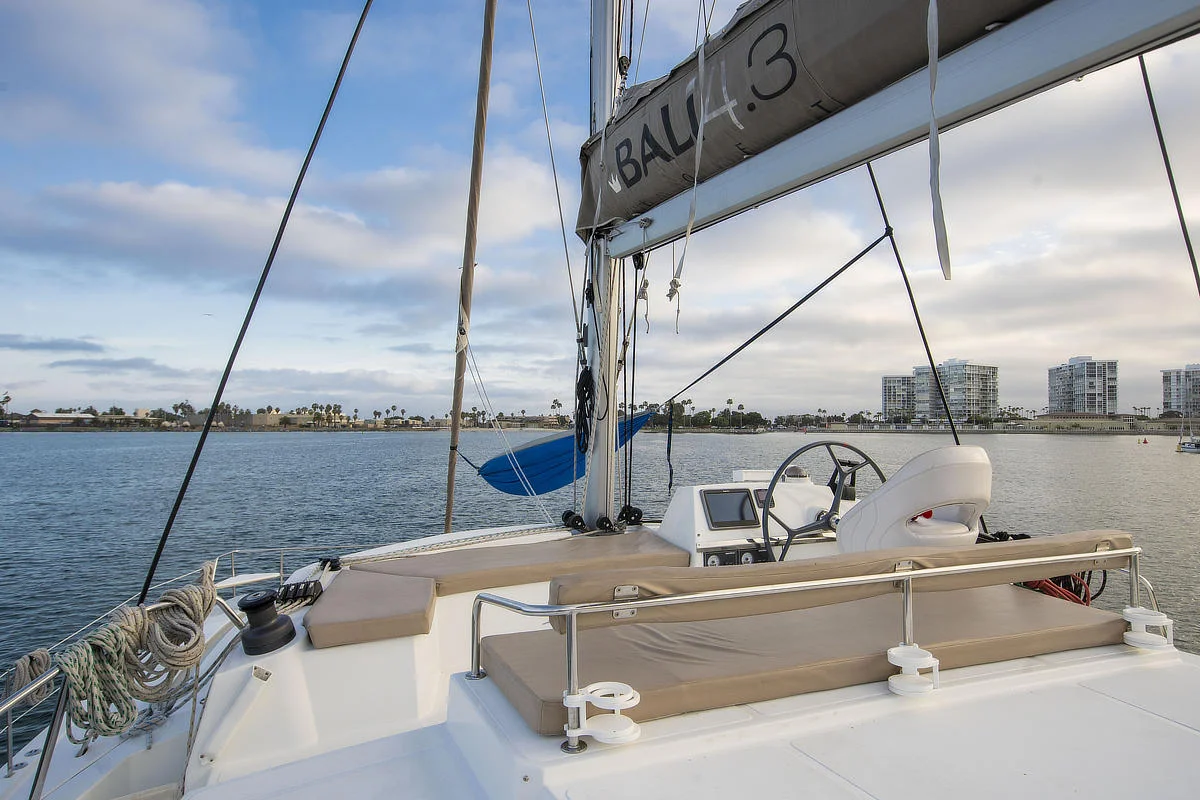
Deck space is where the catamaran argument becomes most concrete for group charters. A 43 to 46-foot catamaran will typically have a cockpit that seats a full group at a single table. On vessels like the Bali 4.3, a solid foredeck with cushioned sun lounges provides additional lounging area forward, giving guests a flat, stable surface to relax on at anchor. The wide stern platform makes boarding from a swim ladder straightforward, and at anchor it functions as an outdoor living room. Below decks, the dual-hull configuration means two full-size cabin corridors, each with its own head, which matters considerably for larger groups.
A comparably sized monohull in the 40 to 45-foot range carries guests comfortably, but the cockpit is narrower and seating is more linear. The social dynamic shifts when guests split between cockpit and cabin rather than gathering at one table. For passages with active sailing, that split is often fine. For a day charter focused on social time, anchoring at a Catalina cove, or a sunset cruise along the Palos Verdes coast, the catamaran layout works better for most groups.
Headroom is a related consideration. Catamaran saloons tend to be taller and brighter because of the wide cabin top and large side windows. Many guests only notice this after they have spent time aboard a monohull that requires ducking through the companionway.
Upwind Performance and Pointing Ability
Monohulls have a genuine advantage upwind. A well-designed keelboat with a deep fin keel can point 35 to 40 degrees to apparent wind and make consistent velocity made good in mixed conditions. Catamarans, because of their beam and inherent buoyancy, typically point 45 to 50 degrees and may make more leeway in steep chop.
For a racing sailor or someone completing offshore passage certification, that distinction matters. For a catamaran charter Marina del Rey day trip to Catalina Island or along the Palos Verdes coast, the difference is nearly invisible to most guests. The majority of charter routes in Southern California involve reaching and running angles where catamarans are fast and efficient. The crossing to Catalina, about 27 to 30 nautical miles from the Marina del Rey breakwater on a broad reach, plays to the catamaran's strengths rather than its limits.
Speed potential is another comparison point. Modern catamaran designs can reach hull speeds well above the traditional displacement formula because they do not need to push through the water the way a heavy keelboat does. In the right conditions, a 40-foot cat on a reach will outrun most comparable monohulls. Guests who want both speed and stability tend to find this combination highly appealing.
Draft, Anchorage Options, and Coastal Access
One practical advantage that often goes unmentioned in catamaran comparisons is draft. Most cruising catamarans draw between 2.5 and 4 feet with daggerboards raised. A monohull of similar length typically draws 5 to 7 feet with a fixed keel.
In Southern California, this matters at anchorages. At Catalina's coves during summer, space fills early. A catamaran can anchor closer to shore, in shallower water, where the holding is often better and swell is more protected. At certain anchorages along the coast, a catamaran occupies positions where a monohull would be aground.
The twin-hull configuration also means a catamaran can sit on a beach at low tide without tipping. This opens up access to swim-ashore spots and beach landings that a keelboat cannot reach safely.
The wide beam does carry one limitation in marinas: slip fees. Many facilities charge by beam as well as length overall, so docking a catamaran costs more than docking a monohull of the same waterline length. This affects long-term slip costs more than it affects charter pricing, but it is worth understanding when comparing ownership economics alongside chartering options.
Planning a group outing in Marina del Rey?
Tell us your group size and target date and our team will confirm which vessels are available for your window.
Why Groups of Six or More Consistently Choose Catamarans
When the BPY team reviews charter inquiries for larger groups, the first preference is almost always a catamaran. The reasons appear in three consistent patterns.
The first is motion sickness history. Guests who have previously experienced discomfort on a heeling monohull will specifically request a cat. The stable, level ride is generally far easier on guests prone to seasickness, and guests who have never sailed before tend to feel more confident when the deck under their feet stays flat throughout the trip.
The second is social configuration. Groups want to stay together. When half the guests are below and half are in the cockpit on a narrower monohull, the group experience fragments. On a wide catamaran cockpit, the whole party gathers at one table facing each other, which is what most groups are actually chartering a vessel to accomplish.
The third is photo and video. Groups celebrating occasions want good images. A level deck, a cushioned sun lounge across the solid foredeck, and a clear stern platform provide far more flexibility for group shots than a heeled monohull with spray coming over the rail.
Our Bali 4.3 Catamaran (Fleet) is one of several Marina del Rey catamaran options well suited to group charters. The cockpit layout, salon headroom, and overall stability make it a strong fit for groups looking for social space on the water. For those interested in handling a catamaran themselves rather than chartering with a captain aboard, the Cruising Catamaran Course teaches the specific techniques catamaran sailing requires, including tacking on wider angles, managing bridgedeck clearance, and docking twin-engine vessels in close quarters.
Where Monohulls Still Have the Edge
A fair comparison includes the cases where a monohull remains the better choice. Guests who are experienced sailors and want the full sailing experience often prefer the connected feel a keelboat provides. The heel, the rail in the water, and the close-hauled beat to windward are sensations a catamaran approximates but does not fully replicate.
For formal sailing instruction, monohulls remain the standard. ASA certifications from 101 through 104 are taught on monohulls because the skill set, including weight shifts, reefing under load, and close-quarters maneuvering with a single engine, transfers directly to offshore passagemaking and the broader sailing world. The catamaran's wide beam and twin engines introduce a different set of handling considerations that are addressed at the advanced certification level.
For passages in heavy weather or extended offshore conditions, an experienced crew may prefer a well-found keelboat with a low center of gravity and proven offshore performance. Catamaran ocean capability has improved substantially over the past two decades, but the sailing community still treats long passages on monohulls as the primary preparation for extended blue-water cruising.
For smaller groups who want an active sailing day rather than a social event, the monohull often fits better. The sailing is more physical, the vessel responds more immediately, and the experience emphasizes seamanship over comfort.
Frequently Asked Questions
How many guests can a catamaran charter Marina del Rey vessel accommodate?
Every BPY vessel, catamaran or monohull, carries a maximum of 12 guests by USCG regulation, regardless of boat size or charter format. Confirm your guest count directly when booking so we can match you to the right boat well in advance.
Do you need prior sailing experience to charter a catamaran?
For a captained charter, no experience is required. A licensed captain handles all sailing and navigation. For bareboat charter, you will need to demonstrate sailing proficiency appropriate to the vessel. Blue Pacific Yachting reviews charter resumes before approving bareboat bookings. The Charter Rules page lists the full qualification requirements and what documentation to prepare in advance.
Is a catamaran faster than a monohull on a day charter route?
On the typical Marina del Rey to Catalina Island crossing, a modern catamaran on a broad reach can be faster than a comparable monohull depending on wind conditions. In light air or on a close-hauled angle, a well-tuned monohull often keeps pace. For most charter guests, the difference in passage time matters less than the difference in on-deck comfort throughout the crossing.
Can a catamaran handle the Santa Monica Bay afternoon sea breeze?
Yes. The afternoon thermal wind in Santa Monica Bay typically builds to 15 to 20 knots in summer. Modern cruising catamarans handle these conditions well when sailed with appropriate canvas. Our captains reef early and conservatively. The wide beam that limits upwind pointing also contributes to a steady, manageable ride as the breeze builds through the afternoon hours.
What is the main advantage of a catamaran for guests prone to seasickness?
The primary advantage is minimal heel. A catamaran at rest or under sail stays close to level, which eliminates the rolling motion that triggers vestibular discomfort for many people. Guests who have experienced seasickness on monohulls frequently report that catamaran sailing is far more manageable. Staying on deck, staying hydrated, and avoiding reading below decks also reduce symptoms significantly.
Catamaran Charter Marina del Rey: How to Book
For groups weighing a catamaran charter Marina del Rey against a monohull option, the practical answer for most parties of six or more is a catamaran, particularly when the goal is social time on the water rather than active racing or formal instruction. Visit Our Fleet to review current vessel specifications and availability, or reach out directly to discuss which platform fits your guest count and planned route.
Ready to get on the water?
Send us your group size and preferred date. We will confirm availability and walk you through the option that fits.