

Sailing Terms Every New Sailor Should Know Before the First Lesson
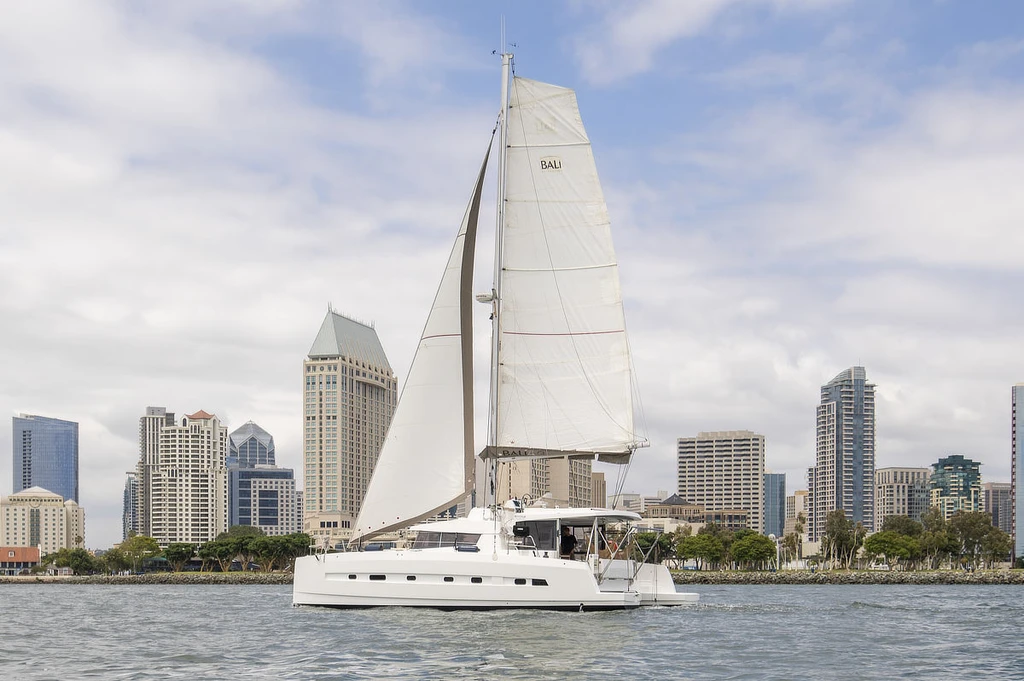
Sailing terms for beginners come down to a short list: port and starboard, bow and stern, windward and leeward, tack and jibe, and the names of the sails and lines. Learn them before your first set of sailing lessons and your instructor's calls will make sense from the first hour on the water.
By Blue Pacific Yachting Team, USCG-Licensed Captains & ASA-Certified Sailing Instructors
What are the sailing terms for beginners to learn before a first lesson?
Our captains and instructors sort the vocabulary into five groups, and each group answers a question a new sailor asks on the dock. Every sailing term in the table below is something you can point at or do aboard, which is why the basics stick quickly. On any sail boat, from a Capri 22 keelboat to a Lagoon 46 catamaran, the same words apply.
| Group | Words to learn | The question it answers |
|---|---|---|
| Location | bow, stern, port, starboard, aft, beam | Where on the boat is it? |
| Wind | windward, leeward, wind direction, points of sail | Where is the wind coming from? |
| Movement | tack, jibe, head up, fall off | How is the boat turning? |
| Gear | mainsail, jib, mast, boom, sheet, halyard | What am I pulling or holding? |
| Calls | ready about, jibe-ho, ease, trim | What did the skipper just say? |
You do not need all of it on day one. The four location words plus tack and jibe carry most of a first lesson, and the rest arrive as you handle the lines. Blue Pacific Yachting teaches and charters from three bases: San Diego, Marina del Rey and Loreto, Mexico. The vocabulary is the same at all three ports.
What do port and starboard bow and stern mean on a sailboat?
Port and starboard, bow and stern are the four words that name every spot on a boat. Stand at the back end, the stern, boat beneath your feet, and face the bow, the front. Port is your left. Starboard is your right. These words stay fixed to the vessel, so a crew member on the foredeck and a person at the helm agree on which side the dock sits, even while facing opposite ways.
Directions on a boat work differently than on land. Sailors give directions relative to the boat, using bow, stern, port and starboard, and relative to the wind, using windward and leeward. Three more location words show up almost at once:
- Aft means toward the stern. "Move aft" means walk back.
- Forward means toward the bow.
- Beam is the width of the boat at its widest point. "On the beam" means straight out to the side.
On a catamaran each hull has its own bow, so you will hear sailors talk about the bows in the plural. Dock lines tie off to the bow cleats and the stern boat cleats, so these words get used within minutes of stepping aboard.
Two memory tricks help. Port and left both have four letters. And at night a boat shows a red light on its port side and a green light on its starboard side, so the color tells you which side of the boat you are looking at, whether boats meet in busy ports or open water.
Points of sail explained: how does a boat sail at different angles to the wind?
Points of sail explained in one sentence: the angle between the bow and the wind direction decides how far you trim the sails and how the boat feels. Start by noting the direction wind is blowing from, because every other choice follows from it. A boat cannot sail straight into the wind. The zone roughly 40 to 50 degrees either side of the wind, depending on the boat, is the no-go zone, where the sails flap and the vessel stalls. Sailors call that being "in irons."
Two words describe the wind's two sides. Windward is the side the wind hits first, and the side boat crews climb onto to keep things level. Leeward, pronounced "LOO-ard," is the sheltered side, turned away, wind reaching it last. Turning the bow toward the wind is "heading up." Turning away from the wind is "falling off," which steers you toward the away wind angles, where the sails ease out.
| Point of sail | Wind comes from | Sails |
|---|---|---|
| Close-hauled | Ahead, as close as the boat can sail | Pulled in tight |
| Close reach | A little ahead of straight across | Eased a little |
| Beam reach | Straight across the side | Eased about halfway |
| Broad reach | From behind, over a back corner | Eased well out |
| Run | Directly behind | Out as far as they go, with the jib sometimes held out on a pole |
The middle of that list, with wind straight across one side, is the easiest place to start, because steady wind keeps the sails full without much fuss. On San Diego Bay and Mission Bay the afternoon sea breeze typically fills in from the west, and the channels and bends keep changing the angle you feel. Sail a few legs and you will hit close-hauled, a reach and a run without trying.
What is tacking and jibing, and how do they differ?
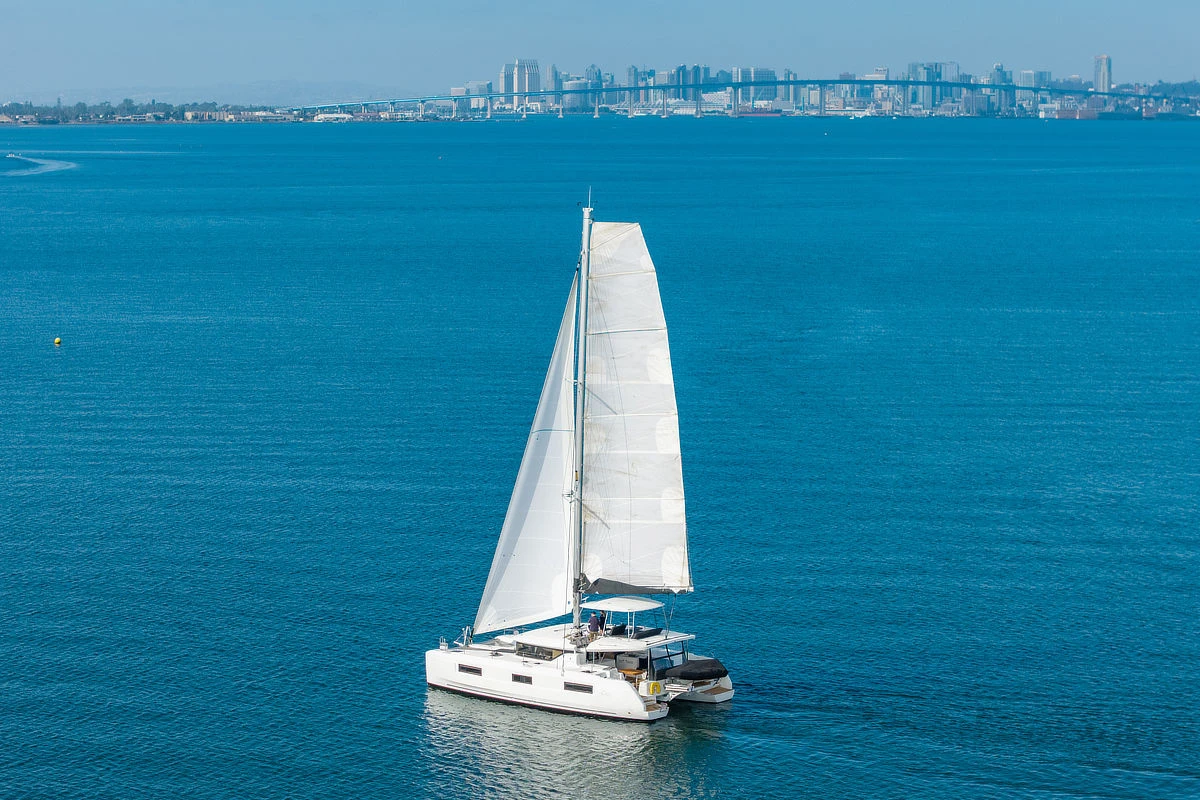
Tacking and jibing are the two ways to turn the boat so the wind crosses from one side to the other. They differ in which end passes through the wind.
- Tacking: the bow turns through the wind. The boat slows, the sails flap briefly in the no-go zone, then fill on the new side. Tacking is how you zigzag against the direction of the wind. On a catamaran, both bows cross the wind together.
- Jibing: the stern turns through the wind. The sails stay full the whole time and the boom swings across fast, so a jibe needs a clear call and a slow, controlled turn. Outside the US you will see it spelled "gybe."
Tack is also the word for which side the wind comes over. With the wind across the starboard side, a boat is on starboard tack. With it across the port side, the boat is on port tack. The starboard-tack boat has right of way, which is why instructors teach the phrase early.
Planning a group outing in Marina del Rey?
Tell us your group size and target date and our team will confirm which vessels are available for your window.
What are sailing definitions for the parts of a sailboat?
Sailing definitions for the parts of a sailboat start at the bottom and work up:
- Hull: the body of the vessel. A catamaran has two hulls and two bows.
- Keel: the fin under the hull that keeps the boat from sliding sideways.
- Rudder: the blade at the aft end of the hull that steers the boat.
- Tiller: the lever attached to the rudder on smaller boats. Push it to one side and the bow turns the other way. Most catamarans steer with a wheel instead.
- Helm: the steering position, or the person steering. "Who has the helm?" is a common question.
- Mast: the tall vertical spar that holds the sails up.
- Boom: the horizontal spar along the bottom of the mainsail.
San Diego students learn on Capri 22 keelboats and carry the same vocabulary onto a catamaran for the five-day liveaboard to Catalina Island. A hull is a hull on every vessel, and a rudder always steers.
What are basic sailing terms for sails, lines and rigging?
Basic sailing terms for the sails start with two names. The mainsail is the large sail behind the mast, held along its bottom edge by the boom. The jib is the smaller sail forward of the mast, also called the headsail. Most boats carry both, and the wind powers them together.
Lines get their own words. A rope sitting on the dock becomes a line the moment it has a job aboard, and each line is named for that job. A halyard hoists a sail up the mast. A sheet pulls a sail in or lets it out: the mainsheet controls the mainsail, and the jib sheets control the jib. A cleat is the metal horn that holds a line fast, and a winch is the drum that gives you leverage on a loaded sheet. Together, the lines and wires that hold up the mast and shape the sails are the rigging.
The word knot has two meanings. It is a way of tying a rope, and the bowline, a knot that makes a fixed loop, is one of the first most students learn. It is also a unit of speed equal to one nautical mile per hour, so a boat making five knots covers five nautical miles in an hour. A nautical mile is about 1.15 statute miles, and it is the standard measure of distance on the water. From the Marina del Rey breakwater, Catalina Island sits roughly 27 to 30 nautical miles away, a passage of about five to six hours. A whisker pole is an adjustable pole that holds the jib out when you sail downwind.
Each nautical term here has one job. A sailing term like "sheet" or "halyard" names the job, not the object, and once those are clear, the rest of the sailing terms for beginners fall into place. A nautical term learned at the dock sticks because you use it within minutes.
What are sailing terms for crew calls and boat handling?
Crew calls are short on purpose. Wind and water carry words away, so the person at the helm announces the maneuver, gives directions to each crew member, and waits for an answer. A tack sounds like this:
- The skipper asks, "Ready about?"
- The crew checks the lines and answers, "Ready."
- The skipper says, "Helm's a-lee," and moves the tiller toward the leeward side, which turns the bow through the wind.
- The crew lets go of the old jib sheet and trims the new one.
A jibe follows the same pattern with "Prepare to jibe?" and "Jibe-ho." Boat-handling words round out the list:
- Trim: pull a sail in.
- Ease: let a sail out.
- Luff: the sail flutters at its front edge because the boat points too close to the wind.
- Head up and fall off: steer toward or away from the wind.
Our Beginning Sailing (ASA 101) students practice these calls early in the course, on the water, where each word is attached to an action.
Common Questions About Sailing Vocabulary
Is sailing terminology hard to learn before a first lesson?
No. Most sailing terminology names things you can point at: the front, the back, the left, the right, a sail, a line. A short list of words covers the basics of a first lesson, and each one gets repeated while you handle the boat. Our instructors teach the words as you use them, so nothing has to be learned from a list.
What are the most common nautical terms for sailboats?
The most common nautical terms are bow, stern, port, starboard, aft, mast, boom, mainsail, jib, keel, rudder, helm, sheet and halyard, plus the maneuvers tack and jibe and the wind words. Those words appear in nearly every sailing conversation, from rigging the boat to docking it after the sail.
Do I need to memorize sailing terms before my first lesson?
No. Knowing the basics, meaning the four location words, helps, and reading through sailing terms for beginners ahead of time makes the first hour feel calmer. But instructors expect a new sailor to start with zero vocabulary. You learn fastest by hearing a word, doing the action, and hearing the word again.
What do sailors say instead of goodbye?
Sailors say "fair winds," or the longer "fair winds and following seas." It wishes a sailor steady wind from a favorable direction and waves running from behind, which push the boat along. It works as a goodbye, a toast and a good luck wish.
What are some cool sailing terms?
"In irons" describes a boat stalled head to the wind. "Close-hauled" means sailing as near the wind as the boat can. "Jibe-ho" is the call before the stern swings through the wind. "Fair winds" is the classic farewell. "Luff" is the flutter of a sail trimmed too loosely. Each of these is an everyday working word on deck.
Practice These Sailing Terms on the Water
Once these sailing terms for beginners feel familiar, the fastest way to make them stick is to use them aboard a boat: pick a class date on the Sailing School Calendar and your instructor will walk you through each term as you sail.
Ready to get on the water?
Send us your group size and preferred date. We will confirm availability and walk you through the option that fits.