

If you are pricing out a day on the water from Marina del Rey and the quotes are not adding up, this marina del rey yacht charter cost guide breaks down base rates, captained vs. bareboat pricing, and the add-on fees that routinely surprise first-time charterers. Browse Bareboat Charters to see the available vessels and rate categories before you request a quote.
By Blue Pacific Yachting Team, USCG-Licensed Captains & ASA-Certified Sailing Instructors
Understanding the Marina del Rey Charter Market
Marina del Rey is one of the largest man-made small craft harbors in the United States, with more than 5,000 wet slips and a charter industry that has operated continuously for decades. That density is good news for anyone pricing a charter: competition among operators keeps rates in a legible range, and the variety of vessel types means you can match the boat to your group size and goals without settling.
The basin sits at the southern end of Santa Monica Bay. Outbound from the main channel, you have open Pacific to the west, Catalina Island about 27 to 30 nautical miles to the southwest, and the Channel Islands beyond that. Most day charters stay within Santa Monica Bay, which offers consistent afternoon sea breeze, manageable swell, and protected water in the lee of the Palos Verdes Peninsula. Catalina passages are the most common overnight objective, a crossing of about 5 to 6 hours under sail in typical conditions, with Two Harbors near 27 nm and Avalon near 30 nm from the breakwater.
Charter rates in this market are set by supply, demand, and vessel economics. Operators build their rates around real operating costs: maintenance, fuel, slip fees, insurance, and crew wages. Understanding that structure helps you read any quote as a cost-recovery document rather than an arbitrary number.
How Operators Structure Their Rates
Most Marina del Rey charter operators price by the time block. A half-day (four hours) and a full day (eight hours) are the standard increments. Some operators offer a shorter sunset cruise window, typically two to three hours, at a lower rate than a half-day because of the compressed time window and reduced operational complexity.
Weekday and off-peak rates are consistently below weekend rates at every operator in this market. If your dates are flexible, a Tuesday through Thursday booking on the same vessel and duration typically comes in below a comparable Saturday charter. The differential varies by operator and season but is worth asking about directly.
Seasonality adds another pricing layer. Southern California is an excellent year-round sailing environment, but summer, Memorial Day through Labor Day, represents peak demand and peak pricing. Spring and fall shoulder seasons often produce favorable wind conditions alongside lower charter rates, making them the practical choice for cost-conscious groups that are not tied to specific vacation dates.
Bareboat vs. Captained Charters: Where the Rate Splits
The first major variable in any charter quote is whether a captain is included. This single decision affects the rate, the qualification requirements for your booking party, and the full character of the experience aboard.
Bareboat Charters
A bareboat charter provides the vessel to a qualified skipper from your group. You are renting the boat with no crew included. The operator will require proof of competency before handing over the dock lines. In practice, that means a resume of documented sea miles, a recognized sailing certification, or both.
ASA certifications are the most common qualifying credential in this market. ASA 101, the basic keelboat standard, combined with ASA 103, basic coastal cruising, is the floor for most bareboat monohull rentals in the 25 to 35-foot class. Larger vessels or offshore passages require additional certifications. If your certifications are current and your logged experience is documented, a bareboat charter is typically the lowest-cost path to time on the water.
The tradeoff is operational responsibility. The skipper in your party is responsible for vessel handling, navigation, weather routing decisions, and safe docking. That accountability is appropriate for experienced sailors and is not suitable for groups without a genuinely qualified helm.
Captained Charters
A captained charter includes a USCG-licensed captain in the rate. The captain handles all vessel operations: departure planning, navigation, sail trim, harbor traffic communication, and docking at both ends of the trip. Your group is aboard as passengers, free to participate as much or as little as conditions and the captain's judgment allow.
Captained charters eliminate the experience requirement for the booking party entirely. There is no credential check for guests. This makes them the appropriate choice for celebrating a birthday or anniversary on the water, for introducing first-timers to sailing, or for any group that wants a polished, operationally transparent day without taking on helm responsibility.
Captain fees are either built into the charter rate or quoted as a flat add-on depending on the operator. On multi-day passages, a first mate is sometimes included or available for an additional fee. Industry standard for captain gratuity is 15 to 20 percent of the charter fee, paid directly to the captain at the end of the trip. Most operators do not include gratuity in their headline rate, so budget for it from the outset rather than treating it as optional.
Vessel Size and Type: A Major Pricing Variable
After the captained vs. bareboat split, vessel size and type produce significant variation in rates across the Marina del Rey charter market. The relationship is straightforward: larger vessels with more amenities carry higher base rates. Worth noting up front: by USCG regulation, every charter vessel in this market carries a maximum of 12 guests regardless of length, so the choice between boats is about comfort and layout, not headcount.
Monohulls
Monohulls are the traditional sailboat form and the most common class in charter fleets. They range from compact day-sailers, which put guests close to the water with a lively, hands-on feel, up to 40-plus-foot coastal cruisers built for full-day or overnight passages. Smaller monohulls represent the lowest-cost entry point in most fleets and are well-suited for groups that want an active sailing experience without paying for space they will not use.
Performance monohulls in the 33 to 40-foot range carry higher rates and broader capability. More sail area, better-appointed interiors for extended passages, and greater stability in coastal conditions are all reflected in the price step. For a group that wants a capable passage-maker for an overnight to Catalina, this class is the practical middle ground.
Catamarans
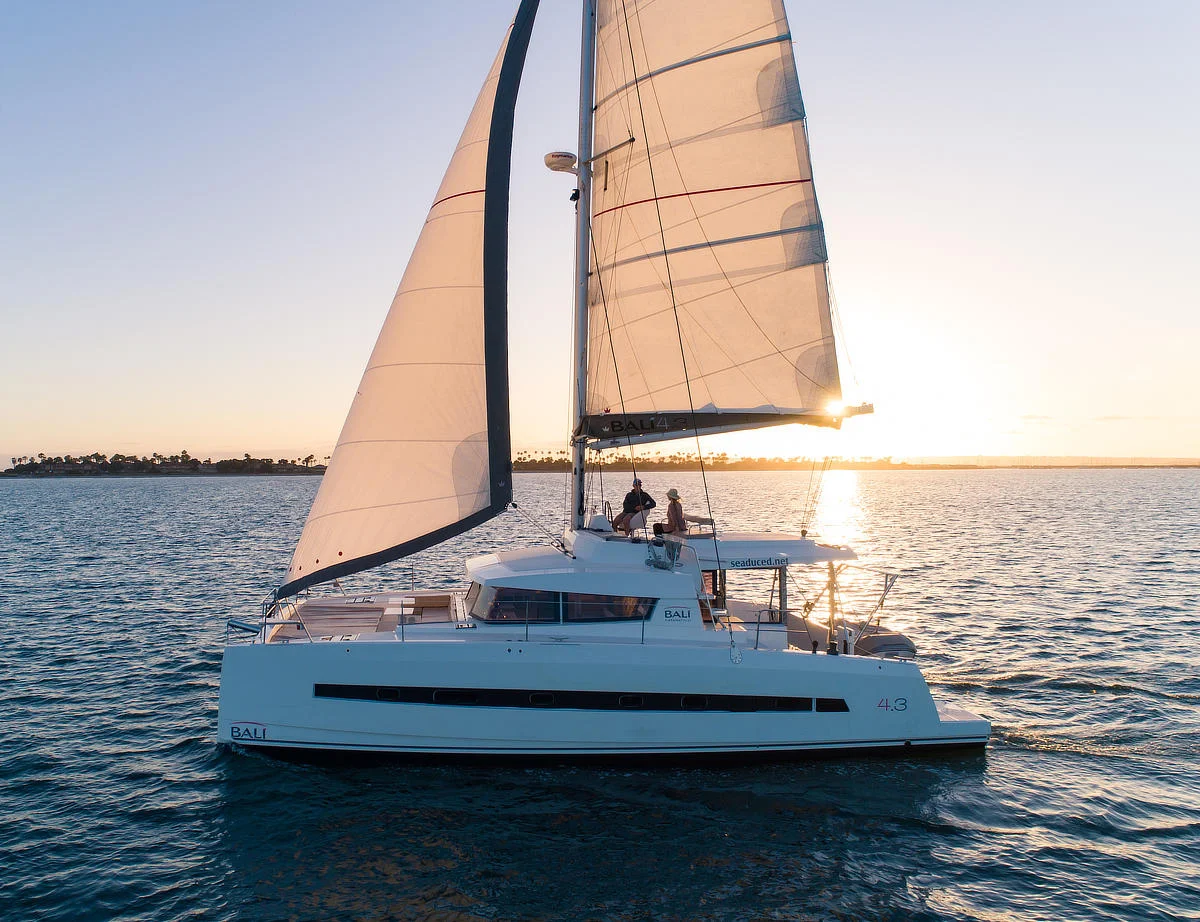
Catamarans carry a rate premium over monohulls of comparable length. The wider beam creates more deck space and cabin volume, stability under sail is noticeably greater, and the overall comfort level for guests who are newer to sailing is meaningfully higher. That added value is priced into the base rate.
For multi-day passages, or for guests who prioritize stability and living comfort over sailing performance, the catamaran premium is usually justified. A 43 to 46-foot cruising catamaran provides twin-hull stability, a cockpit that seats a full party comfortably, and an interior that holds up well on an overnight passage without anyone feeling cramped.
Powerboats
Not every Marina del Rey charter involves sails. Powerboat charters appeal to groups that want speed, operational simplicity, and predictable transit times to a specific destination. Powerboats are priced comparably to monohulls on a length basis but carry fuel costs that sailing vessels typically do not. Confirm the fuel billing method in detail before signing any powerboat charter agreement, as metered fuel billing can vary substantially with speed and distance.
Hidden Add-Ons That Change the Budget
A base rate quote is a starting point, not the final number. The gap between the headline figure and the actual out-of-pocket cost is determined by the items below. Understanding each one before you sign prevents surprises at checkout.
Fuel
Powerboat charters almost always include a fuel surcharge. Some operators quote a flat surcharge; others charge at actual consumption. The distinction matters because actual-consumption billing varies with the destination, sea state, and how the captain runs the throttle. Get the fuel billing method in writing.
Sailing charters handle fuel differently. Engine hours accumulate when motoring in and out of the marina, during light-wind stretches, or when docking at a distant port. Some operators include engine fuel in the charter rate; others meter it separately. Ask explicitly and get the policy confirmed in writing before the charter begins.
Security Deposit
A security deposit hold on a credit card is standard practice across the charter industry. The hold amount varies by vessel value: smaller day-sailers carry modest holds, while larger catamarans may require a hold of several thousand dollars. The hold is released after the end-of-charter inspection, assuming the vessel is returned undamaged. This is not a fee, but it reduces your available credit during the charter window and should be factored into your planning.
Provisioning
You have flexibility here, and it does not have to add cost. Guests are welcome to bring their own food, drinks, and ice aboard at no extra charge. If you would rather not handle it yourself, Blue Pacific Yachting can coordinate catering and, on many charters, an onboard chef so the food is handled end to end. Decide which path you want early so your total cost estimate reflects it, particularly for full-day or multi-day charters where consumption adds up.
Dockage at Destination
If your charter includes an overnight stop at Catalina Island or another harbor, dockage fees at the destination are almost always billed separately from the Marina del Rey base rate. Catalina has multiple harbor options, each with their own seasonal mooring rates. Confirm whether destination dockage is included in the charter agreement or billed separately before signing.
Insurance Riders for Events
Some operators require an additional insurance rider for large groups, for charters where alcohol is served, or for private events with a commercial character. This may add a flat fee to the total quote. Ask at the inquiry stage so the figure is included in your budget before you commit to a deposit.
Using This Marina del Rey Yacht Charter Cost Guide to Compare Operators
Reading the marina del rey yacht charter cost guide correctly means applying the same framework to every quote you receive. A lower headline rate can easily mask fuel surcharges, security deposit holds, or mandatory add-ons that a higher-rate operator already bundles. The only way to compare accurately is to evaluate each quote against the same line-item checklist.
Build a comparison sheet with these fields for each operator:
- Base rate for half-day and full day
- Captain included or bareboat, with the captain fee quoted separately if applicable
- Vessel and layout best suited to your group (every charter vessel seats up to 12 guests)
- Fuel policy: included in rate, flat surcharge, or metered at actual consumption
- Security deposit hold amount
- Provisioning policy: bring your own at no charge, or operator-coordinated catering and chef
- Dockage policy for overnight destinations
- Gratuity expectation on captained charters
- Weather cancellation terms and rebooking policy
That final line item matters more than most first-time charterers expect. Southern California coastal conditions are generally favorable, but offshore weather can shift. Knowing whether an operator issues a full refund, a charter credit, or neither on a weather cancellation protects you if you need to reschedule.
Reviewing a reputable operator's Charter Rules gives you a useful baseline for what a professionally written charter policy looks like. When a competitor's agreement leaves any of those standard items unaddressed, ask the question directly before signing rather than assuming the answer favors you.
Frequently Asked Questions
How much does a yacht charter in Marina del Rey typically cost?
Charter rates in Marina del Rey vary by vessel size, type, duration, and whether a captain is included. A bareboat half-day on a smaller monohull occupies a very different price point than a full-day captained catamaran for a group event. The most reliable approach is to request itemized quotes from two or three operators and compare them line by line rather than headline figure to headline figure, using the checklist in this guide.
Do I need sailing experience to charter a boat in Marina del Rey?
Bareboat charters require proof of competency, typically ASA certifications or equivalent documented sea miles. Most operators in this market accept ASA 101 and ASA 103 as the baseline for smaller monohulls. Larger vessels require additional certifications. If your credentials are not current, a captained charter is the appropriate option, or you can complete an ASA course sequence first to build the qualifications needed for bareboat access.
What is the difference between a bareboat and a captained charter?
A bareboat charter provides the vessel to a qualified skipper in your group, who assumes full operational responsibility for the boat. A captained charter includes a USCG-licensed captain who handles all navigation and vessel management. Captained charters require no sailing credentials from guests and are the standard choice for events, celebrations, and groups new to sailing.
Are fuel costs included in the charter rate?
Fuel policy varies by operator and vessel type. Powerboat charters almost always carry a fuel surcharge, either quoted as a flat fee or metered at actual consumption. Sailing charters handle engine fuel differently: some operators include it in the rate, others charge separately at consumption. Always confirm the fuel policy in writing before signing the charter agreement to avoid an unexpected line item at the end of your trip.
How far in advance should I book a Marina del Rey charter?
For summer weekends, booking four to eight weeks ahead is advisable. Peak-season catamarans and captained event charters fill quickly. Weekday and shoulder-season bookings can often be arranged with shorter lead time and typically come with more competitive rates as an added benefit.
Get an Accurate Charter Quote Before You Book
The most useful marina del rey yacht charter cost guide is one that ends with real numbers for your specific date, vessel, and group. At Blue Pacific Yachting, charter inquiries are answered with itemized quotes that account for every line item covered in this guide, so you know exactly what you are committing to before signing. Start the conversation through our Contact Us page and a member of the BPY team will walk you through the specific options available for your outing.